Post-Purchase Reality: Who Manages Your Asset?
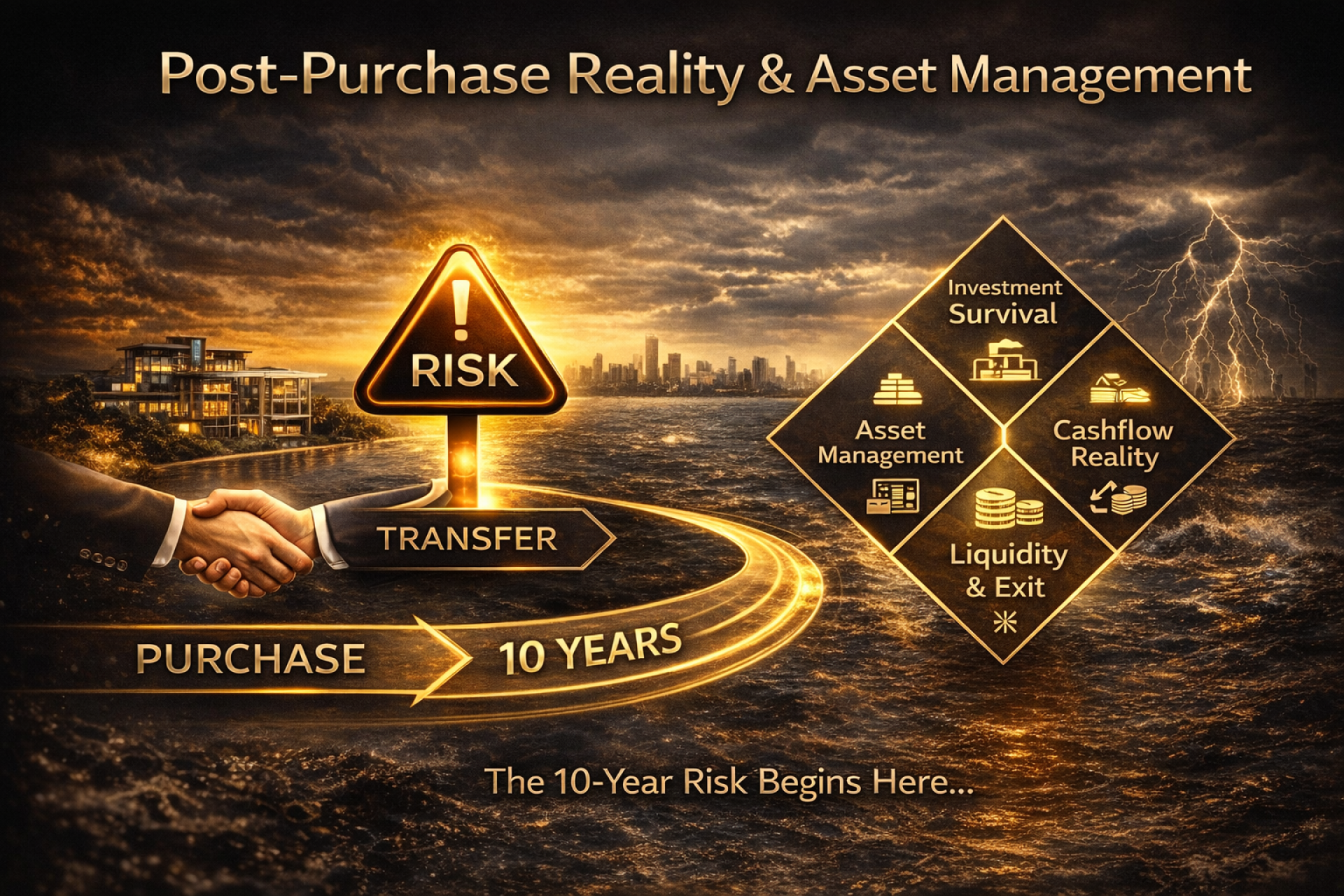
Post-Purchase Reality & Asset Management
“The Truth About Luxury Investment After Handover”
A question every investor ponders, yet few receive a straightforward answer: After transferring tens of millions of baht ...
- Who truly oversees my asset on a daily basis?
- How achievable is the yield presented in the brochure?
- And what are the critical mistakes most owners discover—only when it is too late?
Before diving into the post-handover reality, understanding Phuket’s position in the global eye is the essential foundation for any investment decision. Read More [Thailand’s Position in the Global Branded Residences Market (2025–2030)]
The reality is that luxury real estate investment does not end on the day of transfer. In fact, the transfer date marks the beginning of long-term operational risk. Successful investors do not judge an opportunity by the "most beautiful project," but by the structural survival of the post-transfer financials.
Dimension 1: Post-Handover Asset Management
Asset value isn’t determined on the contract signing date; it is redefined every single day through management standards, involving various hidden risks and values. Read More [Branded Residence: Investment Analysis, Standards, and Risks]
| Investment Factor | Branded / Institutional Management | Local / Owner-Controlled |
| Operational Standards | Consistent 5-star hotel grade maintenance. | Fluctuating standards based on budgets/teams. |
| Maintenance Strategy | Long-term proactive preventive maintenance. | Reactive repairs leading to accelerated aging. |
| Income Stability | Highly resilient NOI, even during market volatility. | High volatility depending on the juristic team. |
| Future Value | Generates resale premium and global demand. | Low liquidity; often sold at a heavy discount. |
⚠️ Investor Warning: A "Sold Out" project at launch does not guarantee a high-performing asset
in the long run without a professional management structure.
Dimension 2: Cashflow & NOI Reality
True returns must be measured by the project’s ecosystem and in-depth net return calculations to prove where the high IRR figures actually originate. Read More [Effect Ecosystem Value: Why Phuket Real Estate IRR Hits 17%?]
| Metric | General Projects | Branded Assets |
| Brochure Projection (Gross) | 7–10% | 7–10% |
| Actual Net Yield (In-Bank) | 4–6% | 6–8% |
⚠️ Investor Warning: Figures that do not account for true operating expenses are merely financial illusions.
Don’t let financial illusions dictate your investment. Understand how we filter only the most resilient assets.
[ Why Professional Vetting Matters? ]
Dimension 3: Liquidity & Exit Risk
| Secondary Market Dynamics | Branded Residences | Non-Branded Projects |
| Exit Strategy | High Liquidity | Difficult / Illiquid |
| Buyer Confidence | Institutional Grade | Low / Uncertain |
| Price Compression | Low (Price floor protection) | High (Under pressure to sell) |
⚠️ Investor Warning: A return that cannot be liquidated is a return that does not exist.
Dimension 4: Tax & Structural Efficiency
Beyond operational profits, tax and legal structures are the critical variables that will sustainably preserve your wealth. Read More [Tax Strategy and Risk Mitigation: Legal & Financial Guide]
| Ownership Structure | Impact on IRR |
| Individual / Personal Name | Subject to high transfer taxes, inheritance tax, and capital gains. |
| Corporate / SPV | Exit flexibility, optimized tax control, and enhanced Net IRR. |
⚠️ Investor Warning: An IRR calculation that excludes tax considerations is an incomplete IRR.
Case Illustration — Bang Tao Beach, Phuket
Luxury Beachfront Condo | 2BR / 2BA | Purchase Price: 30,000,000 THB
| Operating Item | Brochure |
Reality (Non-Branded) |
Reality (Branded) |
| Avg. Occupancy | 85–90% | 65–70% | 78–85% |
| Annual Gross Income | 2.55M | 1.95M | 2.35M |
| Operating Cost | ~20% | ~35%–43%* | ~28% |
| Net Operating Income (NOI) | 2.04M | 1.10M | 1.69M |
| Net Yield | 6.8% | 3.6% | 5.6-8% |
(*) Inclusive of emergency repairs and extra management costs.
7-Year Exit Comparison
- Non-Branded: Exit Price 33–34M THB | Weak liquidity and low demand.
- Branded: Exit Price 38–42M THB | Strong liquidity and institutional-grade confidence.
What Professional Investors Do Differently
- Analyze Post-Handover Management before the aesthetic appeal.
- Calculate NOI based on a Worst-Case Scenario.
- Define the Exit Strategy on day one.
- Structure Tax Efficiency alongside IRR projections.
➕ Advanced Layer: Risk, Governance & Control
Professional investors do not fear volatility; they fear the loss of control post-transfer.
Key Risk & Governance Factors:
- Interest Rate Cycle: Fluctuations impacting asset valuation and financing costs.
- Tourism Demand Volatility: Macro shifts affecting rental stability and occupancy rates.
- FX Exposure: Currency risks impacting net returns for international stakeholders.
- Regulatory & Policy Risk: Legal changes impacting ownership structures and market liquidity.
- Transparency & Rights of Audit: Ensuring the right to audit operator accounts, establish an Owner’s Committee, and maintain the power to change operators if performance benchmarks are not met.
The ultimate conclusion for a sophisticated investor is not just about holding the asset, but knowing the method and timing of the exit to achieve maximum capital gains. Read More [Liquidity & Exit Strategy]
Conclusion — The Reality Investors Cannot Ignore
Investing in luxury real estate is not merely a purchase; it is a holistic analysis of:
- Asset Management: Safeguarding the quality and capital.
- Cashflow Reality: Understanding actual net-in-bank income.
- Liquidity: The ease of exit in the secondary market.
- Governance: Maintaining control and transparency.
Investment-grade real estate requires more than just a purchase—it requires a strategy. See how our independent screening protects your capital. [ Learn More About Our Investment Standards ]
The same asset can produce significantly different financial outcomes. If you seek sophisticated investment planning built on comprehensive, professional insights, we invite you to
→ Request a Private Investment Consultation
References:
- Knight Frank — The Global Branded Residence Report 2025
- Savills — Global Luxury Real Estate Report 2024
- C9 Hotelworks — Asia Branded Residence Market Review 2025
- Cushman & Wakefield — Luxury Real Estate Insight 2023
- Disclaimer: This analysis is based on structural industry data and research. It does not constitute investment advice. Investors should consult with financial, legal, and tax experts before making any decisions.
Disclaimer: This analysis is based on structural industry data and research. It does not constitute investment advice. Investors should consult with financial, legal, and tax experts before making any decisions.