Real Cost of Waiting: Pre-launch vs. RTM Analysis 2026
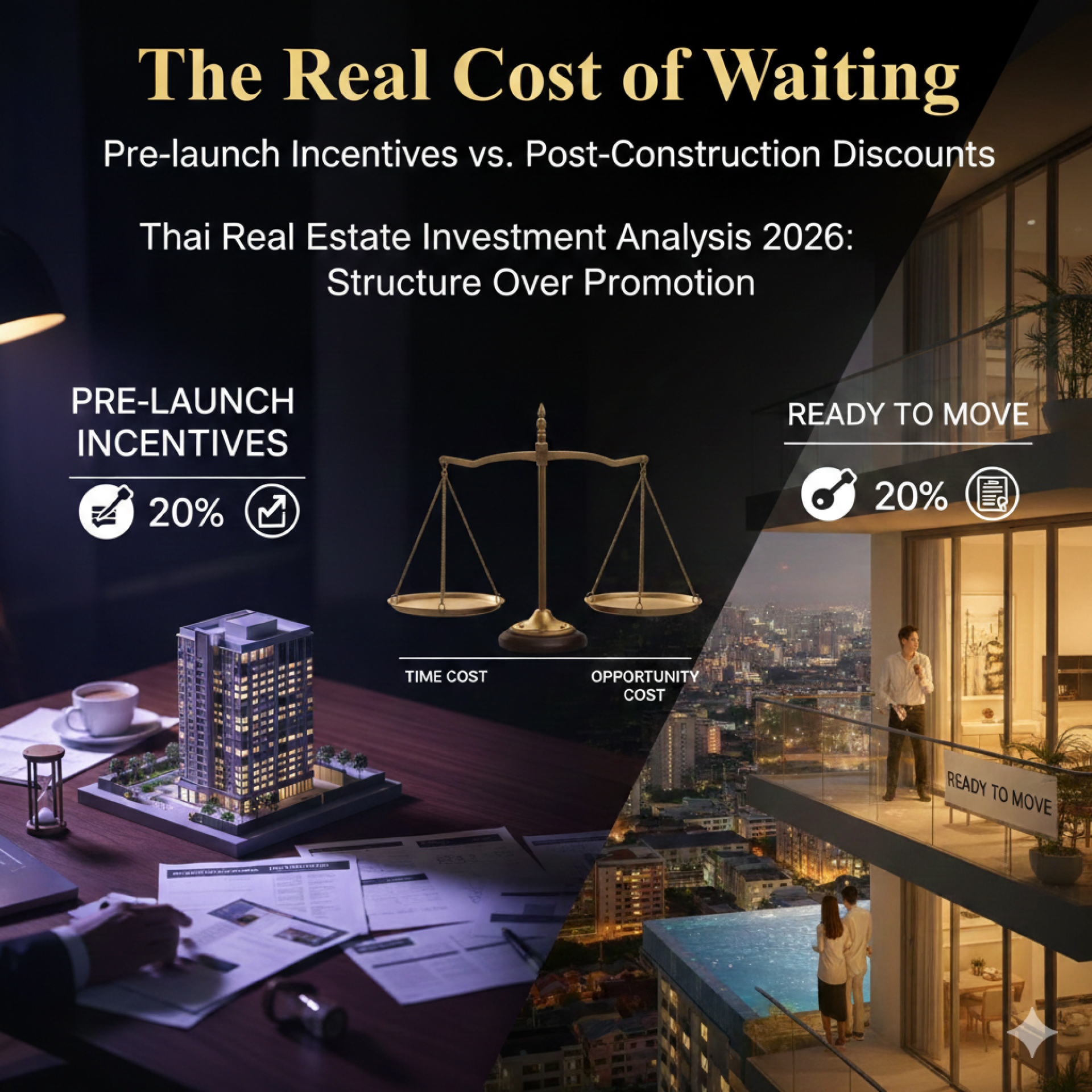
In the 2026 Thai real estate landscape, the most debated question remains: "Should I commit during the Pre-launch phase, or wait until the project is Ready to Move (RTM) for better value?"
In reality, there is no one-size-fits-all answer. Success in property investment is determined not just by "timing," but by the Deal Structure. This article delves into the financial figures behind the scenes to help you make decisions based on hard facts rather than marketing campaigns.
1️⃣ The Pricing Ladder: The Mechanism Driving Investment Upside
Property pricing structures in Thailand typically follow a Pricing Ladder, where valuations appreciate in tandem with construction milestones:
- Pre-launch / VIP Phase: Offers discounts of approximately 15–25% and first right of refusal on "Prime Units." This is the reward for enduring a 2–3 year wait and assuming construction-related risks.
- Construction Phase: Prices generally appreciate by an average of 5–10% as milestones are met. While project risk decreases, the potential upside diminishes accordingly.
- Ready-to-Move (RTM): Prices reflect full current market value. Although this is the most expensive entry point, it offers the critical advantage of immediate Cash Flow through rental income.
Access Our Current Ready-to-Move Deal Pack:
Laguna Beachside (Reef) – 3BR Freehold Residence | Walking distance to Bang Tao Beach
To understand how pricing structure ultimately translates into investor return, read our detailed breakdown on Net Yield vs Gross Yield in Thailand Real Estate.
2️⃣ Structural Comparison: Pre-launch vs. Ready to Move
To illustrate, let’s simulate an investment in a condominium valued at 10,000,000 THB:
| Comparison Items | Pre-launch (2-3 Year Lead Time) | Ready to Move (RTM) |
| Initial Entry Cost | 10,000,000 THB | ~11,500,000 THB |
| Liquidity / Cash Flow | Installment Down Payments | Lump Sum Payment at Transfer |
| Capital Gain | ~1,500,000 THB | Accrues post-transfer |
| Cash Flow (Yield) | Zero during construction | ~4–5% per annum (Immediate) |
| Interest Rate Risk | High (Future uncertainty) | Lower (Immediate rate locking) |
3️⃣ The Crucial Distinction: Capital Gain ≠ Net Profit
The most common pitfall for investors is equating a "20% discount" with a "20% profit." In practice, if you exit within five years, hidden costs significantly erode your margins:
- Special Business Tax (SBT): 3.3%
- Transfer Fee: 1%
- Mortgage Registration Fee: 1%
- Cost of Debt: Interest expenses in leveraged scenarios.
Key Takeaway: Professional investment performance must be measured by IRR (Internal Rate of Return)rather than simple gross margins.
If you would like to calculate your own IRR under different interest rate and growth assumptions, use our TIR Simulation tool here.
4️⃣ Balanced Case Analysis: The Impact of 70% Leverage
Consider a scenario where an investor utilizes 70% leverage (at a 4.5% interest rate) with a 3-year holding period. If the property value appreciates by 15% (1.5M THB) but generates no rental income, the actual IRR hovers around 0–1% per annum–effectively a break-even point.
However, if that same unit generates a 4% rental yield, the IRR jumps to approximately 6–8% per annum. This proves that Cash Flow is the ultimate variable that transforms property acquisition from "speculation" into "investment."
In volatile cycles, leverage can either magnify gains or accelerate losses. Read our Capital Defense in Thailand Property Cycles for a deeper risk framework.
5️⃣ Scenario Analysis: Market Feasibility Framework
Annualized price appreciation vs. estimated IRR (excluding rental income):
- Slow Market: 5% price growth/year (15-16% total) → IRR ~5–6%
- Balanced Market: 7% price growth/year (21-23% total) → IRR ~7–9%
- Premium Market: 10% price growth/year (33-35% total) → IRR ~10–12%
Note: Sustainability Premium: In select prime markets, properties with LEED/TREES certification may achieve stronger rental resilience and improved secondary-market liquidity. Actual performance varies by location and project quality.
Market performance varies by location and liquidity. See our Liquidity & Exit Strategy guide to understand how appreciation converts into realized profit.
6️⃣ Selection Framework: Professional Criteria for Pre-launch
Instead of asking "when" to buy, savvy investors ask if a project survives a Stress Test based on these five criteria:
- Developer Track Record: Proven history of timely delivery and construction quality.
- Location Liquidity: Areas with genuine organic demand, such as Beachfront or Branded Residences.
- Pricing Gap: A minimum 20% discount compared to existing RTM inventory in the same vicinity.
- Exit Market: A clear roadmap for both resale and rental demand.
- Risk Resilience: Does the IRR remain positive if interest rates rise by 1% or if growth underperforms?
- Future-Proofing: Over the long term, the absence of EV-ready infrastructure may reduce a project’s competitive positioning in the secondary market.
Additional Value: Furniture & Fit-out Do not overlook the Incentive Value of "Fully Furnished" packages. These save an additional 3-5% in cash outlay post-transfer, significantly boosting first-year IRR by removing the need for immediate capital expenditure before rental income begins.
Conclusion for the 2026 Investor
In a market sensitive to interest rate pivots and central bank policies, the best investment isn't necessarily the one you "book first," but the one with the most resilient price structure.
Pre-launch is not inherently flawed, and Ready-to-Move is not inherently safe. The key lies in the balance between Capital Structure, Market Cycle, and Hyper-local Liquidity.
In 2026, the real cost of waiting is not just price appreciation foregone, but the compounded impact on IRR, leverage efficiency, and liquidity positioning.
Timing is not a binary choice between Pre-launch and RTM — it is a capital allocation decision shaped by structure, cash flow resilience, and exit clarity.
Ready to Stress-Test Your Deal?
Unsure if your current deal stacks up? We provide expert, case-specific analysis at no initial cost:
✔ Comparative Analysis: Pre-launch vs. Ready Unit
✔ Sensitivity Analysis: Performance across Uptrend / Sideway / Downtrend cycles
✔ IRR Calculation: Including interest rate stress tests
✔ Exit Strategy: Defining your optimal path to liquidity
Explore Our Exclusive Ready-to-Move Collection:
Laguna Beachside (Seashore) – Premium 3BR Residence | Ready to Move In
Contact us for your Private Investment Simulation here
For investors evaluating branded or luxury segments, review our Branded Residences: Investment Value & Growth Risk analysis before committing capital.
References & Disclaimer: Figures and simulations are based on market data from the Real Estate Information Center (REIC), the Bank of Thailand, and international financial reporting standards. Actual returns vary by project quality, location, and market cycles.