Where Does Thai Real Estate Fit into a Global Portfolio?
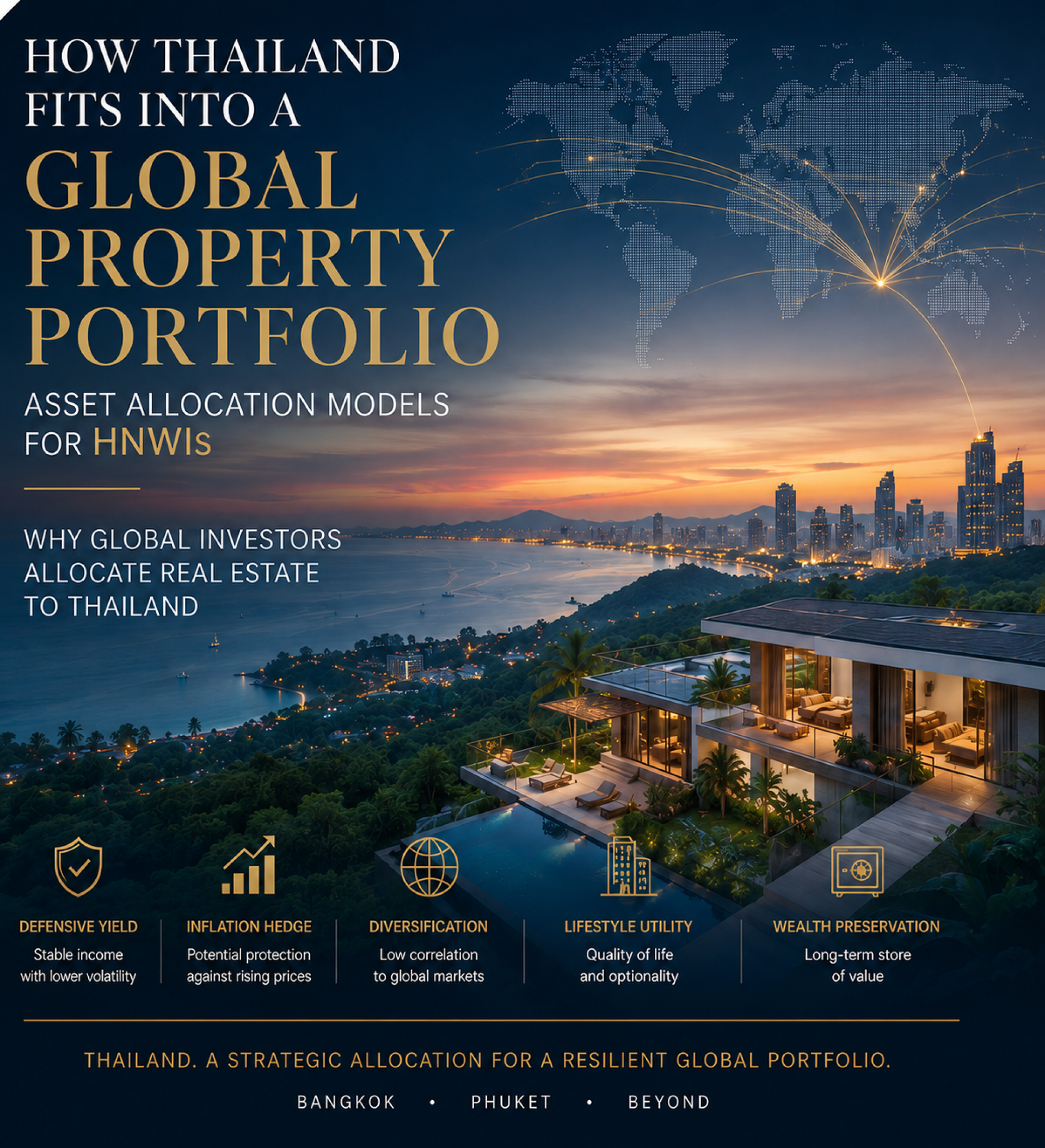
Where Does Thai Real Estate Fit in a Global Investment Portfolio?
An Asset Allocation Perspective for HNWIs and Family Offices
In institutional investing, the key question is rarely:
“Should I invest in real estate?”
Instead, the question is:
“What role should real estate play within my overall portfolio?”
And within that allocation:
“Where does Thailand fit?”
Between 2025 and 2030, investors worldwide are navigating an increasingly complex environment characterized by structural inflation, market volatility, uncertain interest rate cycles, and ongoing geopolitical risks that continue to influence global capital flows.
Against this backdrop, Thai real estate—particularly in Bangkok and Phuket—is increasingly being evaluated as part of a broader global portfolio allocation strategy rather than simply as a lifestyle purchase or speculative investment.
From the Traditional 60/40 Portfolio to Multi-Asset Allocation
- 60% Equities
- 40% Fixed Income
As a result, institutional investors and Family Offices have increasingly expanded their allocations to alternative assets, including:
- Private Equity
- Infrastructure
- Private Credit
- Real Assets
- Real Estate
The objective is not necessarily to maximize returns, but to build portfolios that are more resilient across different economic and market cycles.
The Role of Real Estate in a Global Portfolio
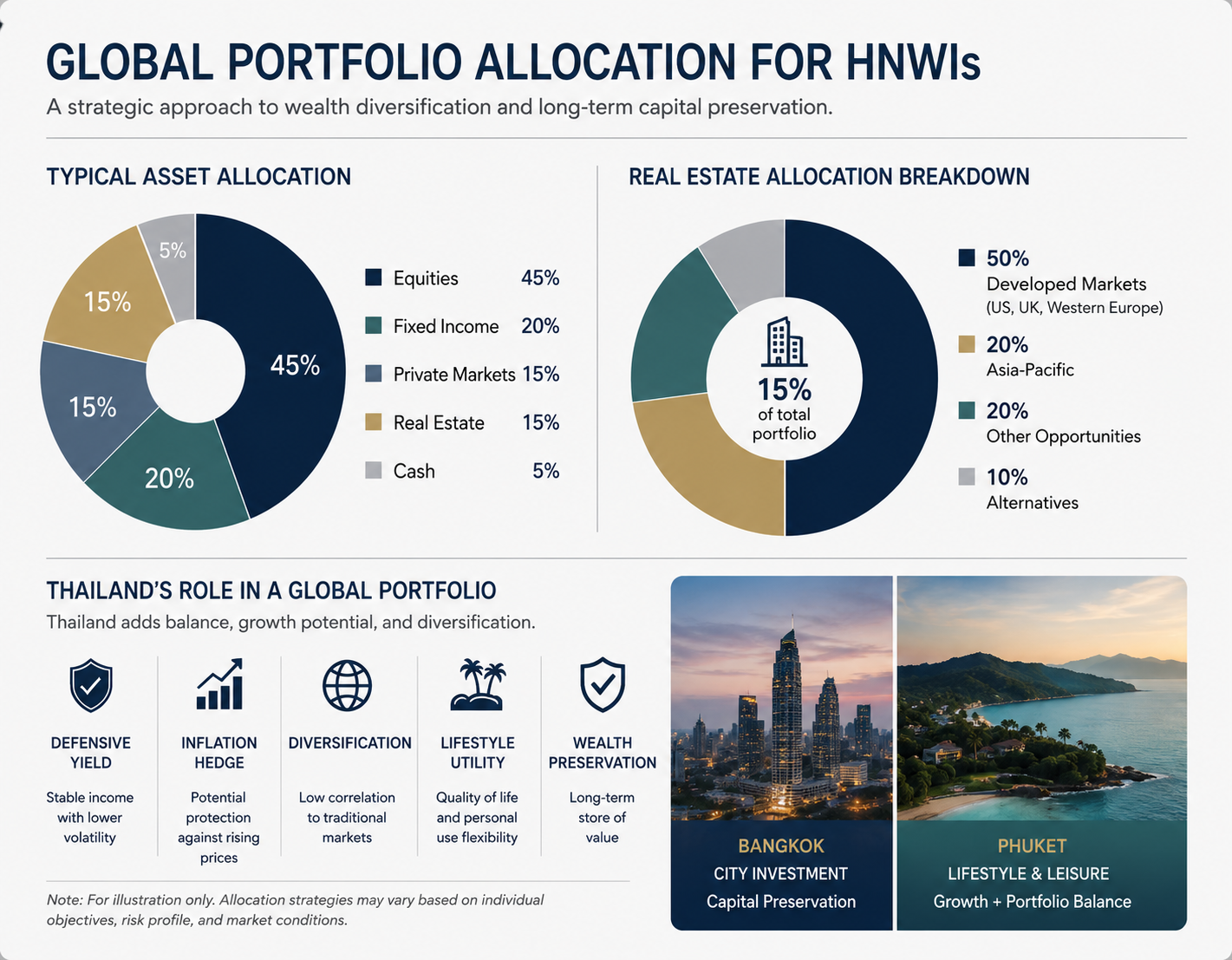
For sophisticated investors, real estate serves purposes that extend well beyond rental income.
1. Defensive Yield
Real estate can provide relatively stable income streams with lower volatility than many publicly traded assets.
2. Inflation Protection
Property values and rental rates often adjust over time alongside inflation, construction costs, and land values, helping preserve purchasing power.
3. Portfolio Diversification
Real estate generally exhibits lower correlation with traditional financial assets, potentially reducing overall portfolio volatility.
4. Wealth Preservation
For many wealthy families, the objective is not always to achieve the highest possible return, but to preserve and transfer wealth across generations.
How Much Real Estate Do Institutional Investors Typically Hold?
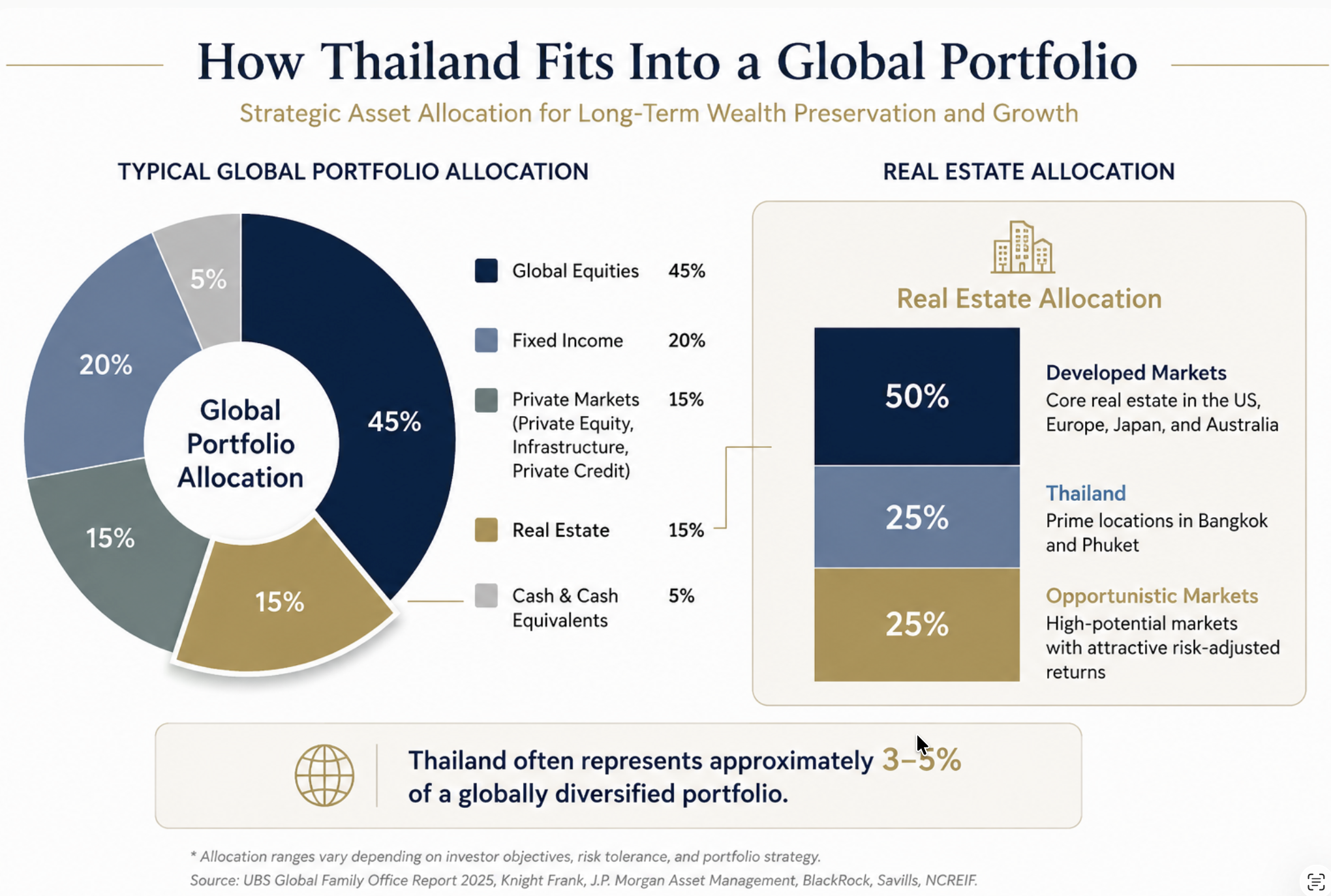
According to allocation frameworks and portfolio models used by leading investment institutions worldwide, real estate often represents approximately:
10–20% of a diversified portfolio
A conceptual allocation may look as follows:
From this perspective, the more relevant question becomes:
How much of a real estate allocation should be allocated to Thailand?
Thailand as a Defensive Yield Market
Compared with several established global property markets, Thailand continues to offer a compelling combination of income potential and relative value.
| Market | Asset Type | Indicative Net Yield |
| Singapore | Prime Residential | 2–3% |
| London | Prime Residential | 2–4% |
| New York | Prime Residential | 2–4% |
| Dubai | Prime / Luxury Residential | 5–7% |
| Bangkok | Prime Residential | 4–6% |
| Phuket | Luxury Branded Residences & Lifestyle Assets | 4–8% |
Indicative ranges only. Yield characteristics vary significantly by asset type, location, management structure, and market cycle.
Thailand therefore occupies an interesting position within global real estate allocations, offering competitive income potential while maintaining acquisition costs that remain substantially below many major international cities.
Why Ownership Structure MattersFor international investors, allocation decisions are influenced not only by returns, but also by ownership security and legal clarity.
Thailand offers several ownership structures that attract global investors, including:
Foreign Freehold Condominiums
Direct ownership rights under Thailand’s condominium framework.
Institutional-Grade Leasehold Structures
Particularly within branded residences operated by internationally recognized hospitality and development groups.
For many investors, ownership clarity can be just as important as projected returns.
Beyond Real Estate: Currency Diversification
Many international investors view Thai real estate not solely as an income-generating asset, but also as a component of broader currency diversification.
For investors originating from jurisdictions experiencing elevated inflation, political uncertainty, or currency volatility, Thai real estate may contribute to:
- Currency Diversification
- Regional Wealth Preservation
- Capital Relocation Strategies
within a globally diversified portfolio.
Bangkok and Phuket: Two Distinct Roles Within a Portfolio
Bangkok: A Core Urban Asset
Bangkok typically functions as a core allocation due to:
- Economic significance
- Long-term domestic demand
- Greater market liquidity
- Broad occupier base
Its primary role is often capital preservation and portfolio stability.
Phuket: A Lifestyle and Yield Asset
Key drivers include:
- Global tourism demand
- Long-stay migration trends
- Wellness economy growth
- Branded residences
- International buyer demand
As a result, Phuket is often viewed as a blend of lifestyle utility, income generation, and long-term appreciation potential.
Market Intelligence: Observations from Phuket’s Luxury Residential Market
While Phuket is often positioned as a lifestyle and yield-driven market, liquidity remains an important consideration—particularly at the higher end of the market.
In practice, properties without an established brand, international distribution network, or clearly defined secondary market can take significantly longer to resell than many investors initially expect.
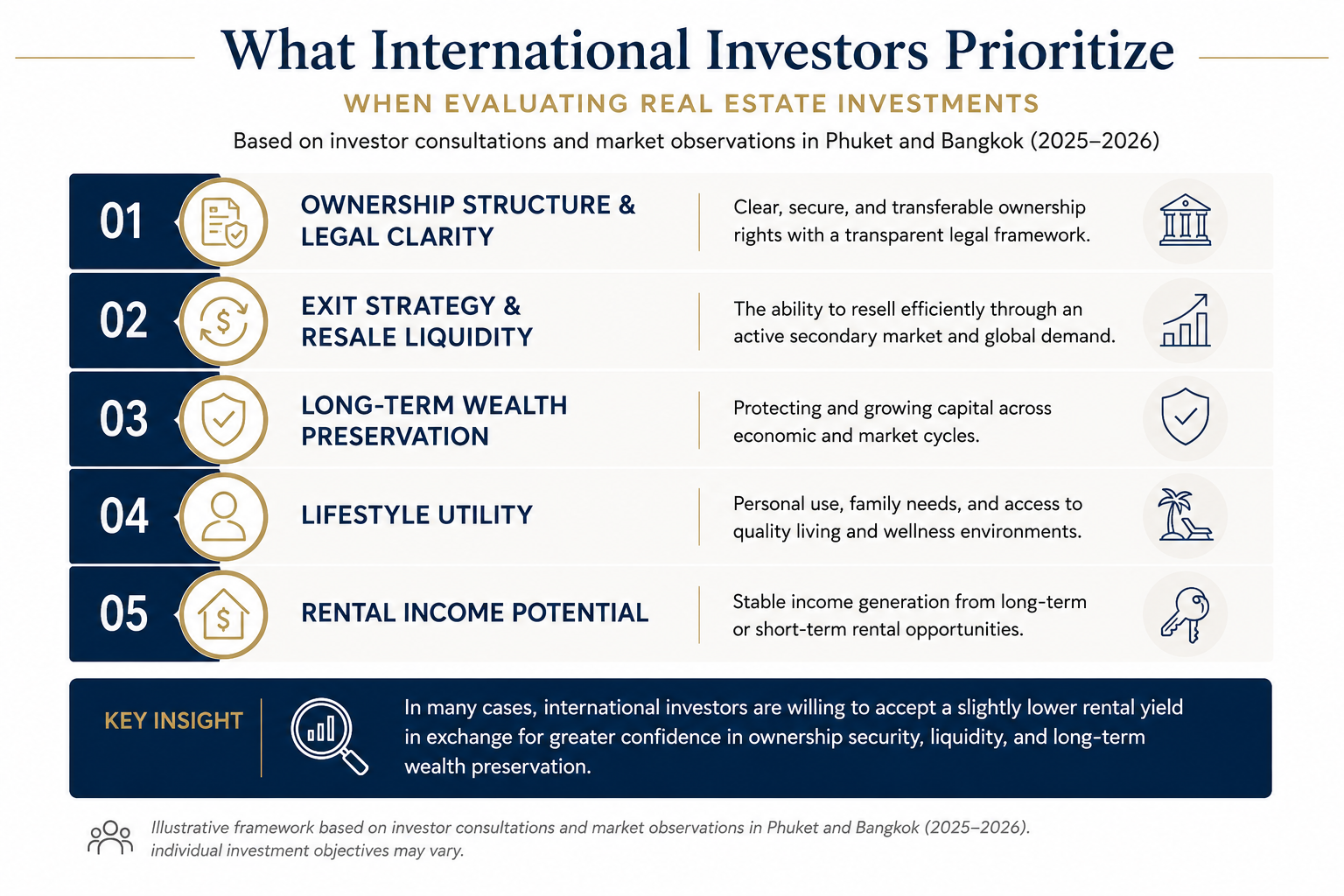
Transaction data involving buyers from Europe, Russia, Singapore, and Australia over the past year indicates that yield is often only one component of the decision-making process.
Many investors place equal–or even greater–importance on questions such as:
- How is ownership structured?
- Who is the likely future buyer?
- How transferable is the asset?
- What role does the property play within the broader portfolio?
Case Study: Real Investment Analysis for an International Client
The following example is based on an actual investment analysis prepared for an international client, with certain details adjusted for privacy.
Property Type: Branded Residence
Location: Phuket
Configuration: 2 Bedrooms
Size: Approximately 145 sqm
Ownership: Freehold
Launch Price: Approximately THB 30 Million
Additional benefits included:
- Up to 45 owner-use nights annually
- Global hotel exchange privileges
- Premium membership benefits
- Long-stay residency-related privileges (subject to program terms)
Instead, the decision was based on a combination of:
- Asset quality
- Ownership structure
- Resale potential
- Family usability
- Portfolio diversification benefits
Liquidity Often Matters More Than Yield
Real estate is inherently less liquid than equities or fixed income investments.
The critical question is therefore not:
“Can I sell?”
but rather:
“Who will buy?”
In the premium segment, assets such as:
- Branded Residences
- Prime Bangkok Residential Assets
- Ultra-Luxury Phuket Properties
often benefit from stronger secondary-market demand supported by international buyer networks.
Tax Efficiency and Intergenerational Wealth Planning
For many affluent families, the focus eventually shifts from wealth creation to wealth preservation and intergenerational transfer.
Thailand’s tax environment differs from many developed markets in several respects.
However, tax planning remains highly dependent on individual circumstances, residency status, and international tax considerations. Investors should always seek advice from qualified tax and legal professionals before making investment decisions.
The Goal Is Not Maximum Return
Retail investors often ask:
“What yield does this property generate?”
Institutional investors are more likely to ask:
“How does this asset improve the overall portfolio?”
This distinction reflects the difference between:
Asset Selection
and
Portfolio Construction
Conclusion
Rather, it can serve as a component within a broader asset allocation strategy that contributes to:
- Income Generation
- Inflation Protection
- Diversification
- Lifestyle Utility
- Long-Term Wealth Preservation
“Will Thailand deliver the highest return?”
Instead, the more relevant question may be:
“Can Thai real estate strengthen the overall resilience and efficiency of a global portfolio?”
For many international investors, that is precisely why Thailand continues to earn a place within long-term global wealth strategies.
Private Asset Consultation
If you or your Family Office are evaluating institutional-grade real estate opportunities in Bangkok or Phuket as part of a long-term wealth strategy, Angie Phuket Residences can assist with:
- Ownership structure analysis
- Portfolio allocation discussions
- Comparative investment assessments
- Preliminary financial modeling
- Liquidity and exit strategy evaluation
Schedule a Strategic Consultation with Our Advisory Team
References
- CFA Institute
- Yale Investments Office
- UBS Global Family Office Report 2025
- J.P. Morgan Asset Management
- BlackRock
- Knight Frank
- Savills
- MSCI
- National Council of Real Estate Investment Fiduciaries (NCREIF)
Additional Market Intelligence
Certain observations contained in this article are derived from investment analyses, advisory engagements, and buyer behavior trends observed by Angie Phuket Residences within Phuket’s international residential market during 2025–2026.
Disclaimer: This article is provided for informational and educational purposes only and does not constitute investment, tax, legal, or financial advice. Investors should seek independent professional advice before making any investment decisions.